
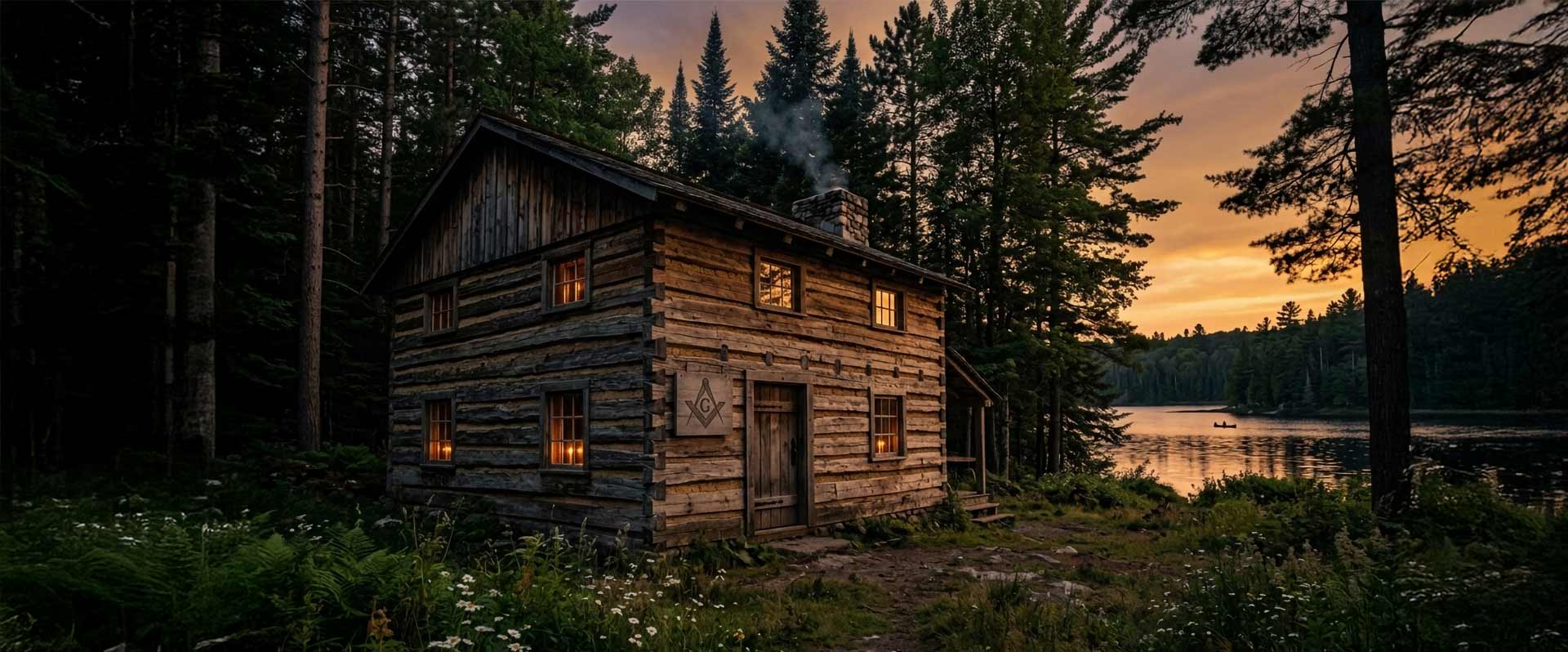
As a Canadian, my family history has always mattered to me. As a Master Mason, a Companion of the Royal Arch, and a 32nd Degree Scottish Rite Mason, it matters even more. I do not look at history only as a record of dates and geopolitical events; I look at it through the lens of obligations taken, values carried, and the quiet sacrifices men make when life is entirely upended.
As a tenth-generation descendant of the United Empire Loyalists, my connection to this land runs deep. My ancestors were men and women who sacrificed their homes, livelihoods, and comfort to carve a new existence out of an unbroken wilderness. But since being raised as a Master Mason back in 2013, I find myself looking at their exodus from an entirely different vantage point. I no longer just see refugees of the American Revolution; I see Brethren carrying the timeless principles of the Craft into the raw Canadian bush, using our moral framework to stay grounded when their entire world had been turned upside down.
For these displaced Masons, the journey northward was a rough and rugged road. Yet, amidst the chaos of fleeing across borders and navigating uncharted rivers, they fiercely protected what mattered most: their Lodge warrants and chests. Consider the Brethren of Sussex Lodge No. 5. Born inside the tents of Sir John Johnson’s King’s Royal Regiment of New York during the war, these men refused to let their fraternal fire dissolve when the regiment disbanded. They carried their charter across the St. Lawrence River to Prescott, ensuring that administrative disruption would not break their sacred chain of continuity. A warrant isn’t just a piece of paper; it is the lifeblood of a Lodge.
When they finally arrived in Upper Canada, the work of rebuilding began. In the 1790s, under Provincial Grand Master William Jarvis, a network of log-cabin lodges emerged. The human drama behind these efforts is staggering. Take Robert Land, a Loyalist who fled to the future site of Hamilton believing his entire family had been slaughtered in the war. For years, he lived in absolute isolation, clearing the heavy timber and building a primitive cabin. Yet, he eventually helped lay the enduring foundations for Barton Lodge No. 6. Years later, he discovered his family was alive, and they were miraculously reunited.
This isn’t just another pioneer history lesson, but a testament to the Master Builder mindset. Physically, these men used axes to fell trees; morally, they used the square, level, and plumb line to erect a civilized community out of absolute chaos.
Life in those early Canadian lodges was unforgivably raw, a reality reflected in how they managed their daily affairs. Hard currency was virtually non-existent in the wilderness. To survive the shortage, the Brethren of Barton Lodge voted unanimously in December of 1799 to allow members to pay their annual dues in “good merchantable wheat,” delivered straight to a brother’s local mill.
On the surface, it sounds like a simple old-world custom. But to me, and especially to a Mason, it speaks of something far deeper. Wheat is not just a commodity; it is Corn, the fundamental wage of a Fellow Craft. It speaks of provision, fellowship, and blessing. By paying in wheat, those pioneers were beautifully tying their survival in the physical world to their spiritual duties within the Lodge. It is a poignant reminder that what we give to the Craft should be real, measured, and worthy.
Yet, the true strength of their Masonic obligations was put to the ultimate test in the winter of 1800. Upon reading that the Brethren of Barton Lodge voted to purchase black ribbon, mourning Brother George Washington for a full six months after his passing, I had to pause. These men had been stripped of their properties, labelled traitors, and exiled by the very revolution Washington led. Yet, sitting by candlelight in a drafty Canadian cabin, they chose to honour the Brother over the political adversary.
That is where the beauty of our journey lies. It is not in grand language or polished ceremony alone, but in the steady, unbroken connection between heritage, duty, and brotherhood. We sit in beautifully lit, modern Lodge rooms today because they were willing to hold Lodge by candles, surrounded by the howling winter winds of an uncharted forest.
As a tenth-generation descendant who shares their secrets, I know we are the living stones of the temple they started building over two centuries ago. The value of the journey is found in the reflection it leaves behind, and it is now our turn to ask what we are building for the generations yet to come.
S&F
Sources & Historical Citations
-
The Regimental & Early Upper Canada Lodge History: The comprehensive historical record detailing how Sussex Lodge No. 5 was formed within Sir John Johnson’s regiment, its operation as New Oswegatchie Lodge, and its evolution up to 1822 is preserved via the historical research papers hosted on the Grand Lodge of British Columbia and Yukon Official Domain. Specifically, their digital archive preserves the Sheppard Ledger Records on Early Upper Canada Masonry, which explicitly documents these wartime origins.
-
The 1855 Hamilton Convention Proceedings: To verify that Sussex Lodge was the first lodge listed on the roster during the formation of the independent Grand Lodge, researchers can look at the digitized primary convention minutes. The complete, historical annual logs are preserved and accessible through the Internet Archive Digital Library, which holds public assets like the Proceedings of the Grand Lodge of A.F. & A.M. of Canada in the Province of Ontario.
-
Loyalist Military Records: For verification on the specific movements and disbanding of Sir John Johnson’s men in 1783–1784, the primary references link back to the King’s Royal Regiment of New York master muster rolls, tracked across Canadian Loyalist settlement land grant registries.
-
Barton Lodge Dues Paid in Wheat (1799): Verified through the primary meeting minutes of The Barton Lodge, No. 6 (Hamilton, Ontario) dated December 11, 1799. The complete transcription is preserved in the Historical Sketch of the Barton Lodge No. 6, G.R.C., A.F. and A.M. Archive, which explicitly records the unanimous vote to accept merchantable wheat at Brother Rousseau’s mill in lieu of cash.
Submit your review | |